
Industrial contamination may occur without visible signs as ions like chloride, sulfate, nitrate, phosphate, or organic acids enter via water, materials, cleaning, handling, or storage. An anion test identifies these ions to trace sources and support process control.
Why Ionic Contamination Is Difficult to Trace
Ionic contaminants can move across materials, equipment, water, tools, packaging, and surfaces, so the source may occur earlier in the process.
- Minerals or salts in process water
- Residues from detergents and cleaning chemicals
- Flux or processing chemicals left on electronic assemblies
- Contaminated tools, gloves, containers, or work surfaces
- Variations between raw material suppliers
- Carryover between production batches
- Exposure during transport or storage
- Surface-treatment and plating processes
General cleanliness measurements may indicate that contamination is present, but they cannot clearly identify the specific ions involved. Using an anion test in a laboratory allows for the separation and measurement of individual ions, providing more detailed information and helping to more accurately identify the source of contamination.
How Anion Test Results Support Root Cause Analysis
Root cause analysis requires more than confirming that a sample is contaminated, as the investigation must connect the chemical finding with a material, process step, or environmental condition, and anion test results can support this work in several ways.
Comparing Acceptable and Affected Samples
Manufacturers can compare normal and affected samples to identify differences in ions such as chloride, sulfate, or nitrate, which may guide further investigation and help narrow down potential contamination sources.
- Rinse water quality
- Cleaning solutions
- Human handling
- Storage near saline environments
- Chloride-containing process chemicals
The result does not confirm the source by itself, but it helps reduce the number of possible causes.
Tracking Contamination Through Production Stages
Samples can be collected after selected stages of production to determine when an ion first appears or begins to increase.
| Production Stage | Possible Sample |
| Incoming inspection | Raw material or supplier component |
| Cleaning process | Cleaning solution or rinse water |
| Surface treatment | Bath solution or treated component |
| Assembly | Partially assembled product |
| Final production | Finished component |
| Packaging | Product after packing and storage |
Testing samples from several stages can show whether contamination was already present in the incoming material or introduced later during manufacturing.
Comparing Suppliers or Production Batches
Anion analysis can be applied when products from different suppliers or batches show inconsistent performance, as comparing results may reveal higher sulfate in one chemical batch, variations in chloride between water sources, phosphate residues after cleaning, differences in weak organic acids, or changes linked to new raw material suppliers, helping support supplier evaluation, incoming quality control, and process qualification decisions.
Applications in Electronics Manufacturing
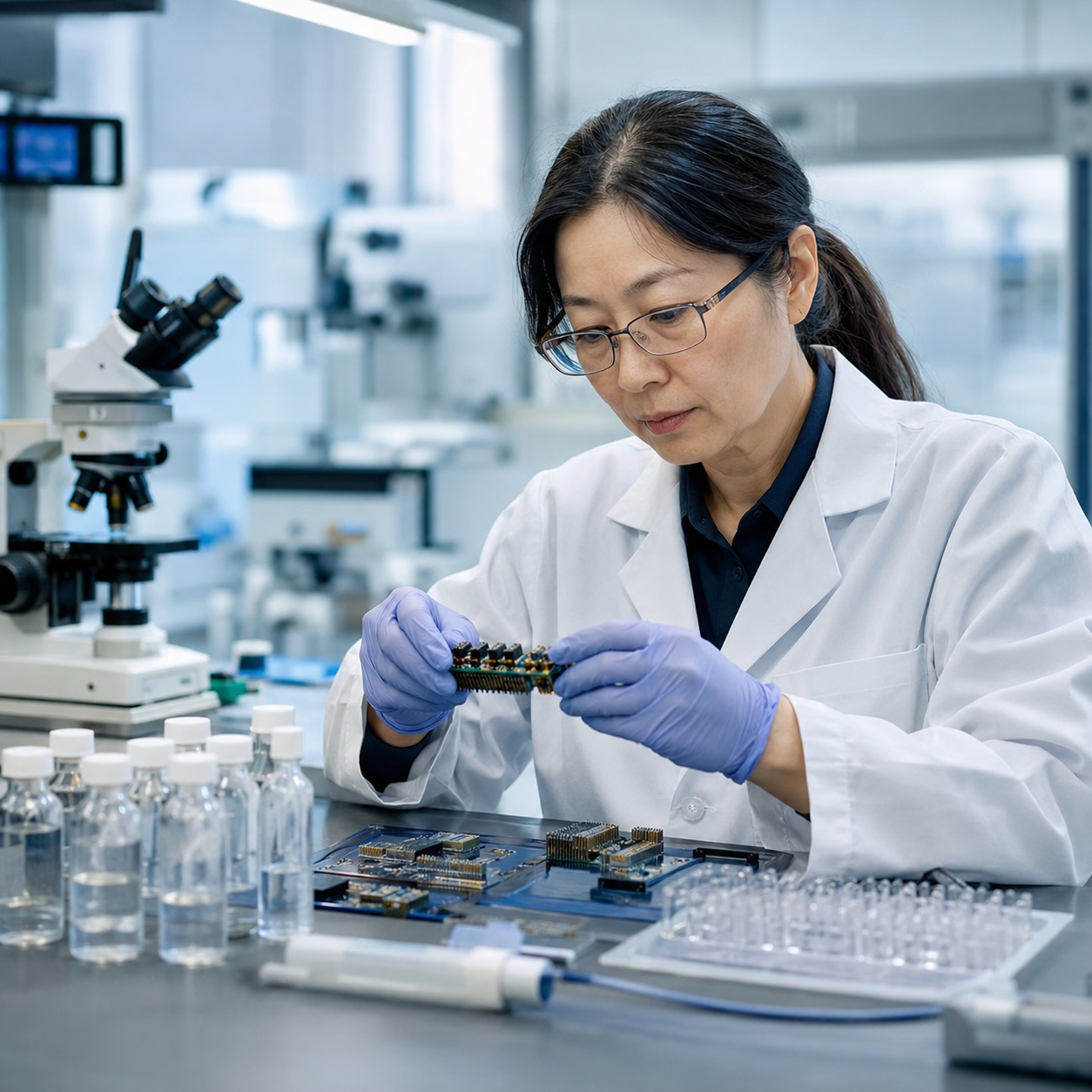
Electronic products are sensitive to ionic residues that may react with moisture and electrical potential. Anion testing is applied to circuit boards, connectors, sensors, and various modules. Residues may originate from flux, rinse water, or manufacturing processes, and can lead to corrosion, electrical leakage, or long-term performance issues.
Applications in Water and Chemical Processes
Water and chemical solutions can carry ions into many parts of a manufacturing system, even when the final product is solid. Contamination may originate from liquids used earlier, making it harder to identify without proper analysis.
Samples for anion analysis often include process water, rinse water, ultrapure water, cooling water, cleaning solutions, chemical baths, raw material solutions, and wastewater. Changes in ion levels may indicate system issues or contamination.
Selecting Samples for a Contamination Investigation
A well-planned sample set improves laboratory results by providing clearer context. Submitting only one failed component may limit understanding, especially when the contamination source is unknown.
A useful investigation includes affected and control samples, different batches, raw materials, water, and chemicals. Proper labeling, handling, and storage details help ensure accurate and reliable results.
Interpreting the Laboratory Findings
Anion test results are typically reported in units such as milligrams per litre for liquids or micrograms per unit area for surface extracts. Reports may also include detection limits, preparation details, test methods, and quality control information.
A detected ion does not always indicate product failure. Interpretation should consider concentration, sample type, residue location, specifications, and historical data. Trend analysis and repeated testing help confirm contamination patterns and process consistency.
Anion Testing Services in Malaysia
Manufacturers in Malaysia operate across electronics, automotive supply chains, chemicals, and precision industries. These sectors often require laboratory analysis to investigate corrosion, product inconsistency, process variation, or unknown residues.
Alstesting Laboratory Testing service in Malaysia supports industrial customers with anion analysis for water, chemicals, and materials. An anion test helps compare samples, trace contamination sources, and support quality control.